Sunday, January 29, 2012

Timket!


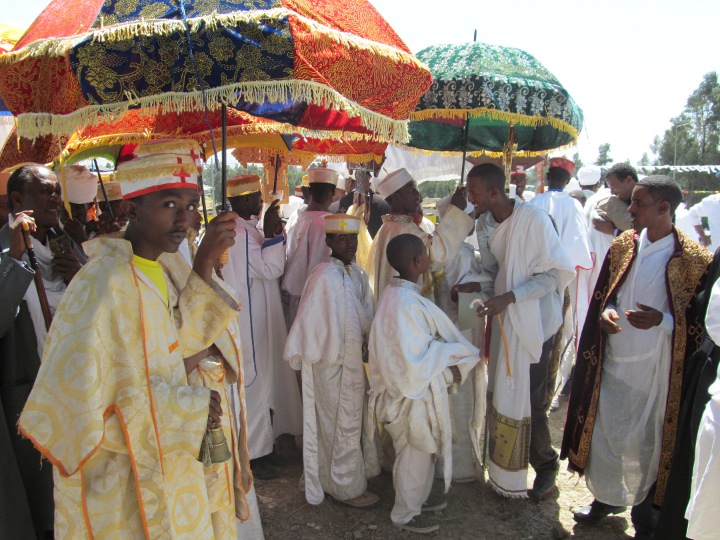
 When you travel to Ethiopia, you automatically become seven years and some odd days younger! In Ethiopia, the year is 2004, due to the difference between the Gregorian and Ethiopian calendars. Hence, Ethiopia celebrated Epiphany on January 20th. Ethiopians gave little thought to Christmas itself, however, Timket (Epiphany) literally stopped traffic. The streets were closed and people flocked to every city center. Each church's respective cross was marched in procession, returning it to “his” church, as Gudisa, one of the athletes, explained. Women wore traditional garb, white gauzy fabric draped over layers of other white fabrics. Hair was extravagantly dyed and braided for for occasion. As the crowd slowly moved down the street, people chanted and danced, their exuberance uncontainable. Gudisa told me repeatedly, “See, they are very happy. This is our culture.”

Men holding sticks circled up with more chanting, singing and jumping. Two men wore lion's manes on their heads, the fur framing their faces as they chanted and banged their sticks along with the rest. The group took turns sending two men into the center to “fight,” hopping around and clashing their sticks together as all of the men surrounding them continued to sing and hold their sticks triumphantly, as if they were guarding the unfolding battle.
After prayers were blasted over a loudspeaker, the cross was processed onward. The men closest to the cross looked like they themselves were adorned alters, dressed in heavy, gilded robes. And surrounding them were men dressed like bishops, too many to count, with peaked hats and incense swinging. Following them, men in T-shirts walked behind, slunched-over, rolling up carpets and passing them forward to be laid on the ground in front of the cross. More men in T-shirts managed the crowd, pushing onlookers (including me) aside to make way for the cross. Everyone stood in the intense mid-day heat for hours, watching and advancing slowly with the procession.


Though a significant holiday for Ethiopians, Timket means additional work for the maids; Tigist, Ababa, and Yevtu have been cooking and cleaning furiously, yet merrily, for over a week! The large carpets that cover the entirety of the living room floor were removed and scrubbed by hand, then returned, then taken back outside to repeat the cleaning process, as Baz claimed that they smelled, though my sensitive nose was unaware. The same was done with the curtains and tablecloths. It is spring cleaning in overdrive.
Tigist, Ababa & Yevtu working away
The walkway between the house and the maids' quarters in the backyard has become an extended kitchen. One or all of the three girls is usually squatting there, cutting up sheep stomach, an Ethiopian delicacy, chopping onions, or cleaning chicken and two large pots are perpetually bubbling away on two new stoves. The fridge overflows with fresh, raw meat. Removing or returning anything to the fridge has become a puzzle, a serious, potentially messy puzzle, with dire consequences of a spilled tupperware of doro wat or a tumble of three dozen eggs that have been carefully, though precariously, stacked on the door. Considering the exorbitant amount of meat sitting in buckets in the backyard and chilling in the fridge, and the hours of cooking that have gone on, it comes as no surprise that the maids slaughtered no fewer than two goats and eight chickens!

Tuesday, January 17, 2012

The "Ugly Girl's" Triumph

“She was a very ugly girl! We Ethiopians see beauty in a straight nose, good hair, and big eyes, a face that is all eyes.” This was Baz's response, with no intentions of leaving out any of the drama of the story, when I asked, simply, “Where we were going?” Baz had requested that I come along to a “small family party” and feeling a little homesick, I was eager to attend. She also enjoys, in her own words, “showing me off” at her office and friends' houses and I'm happy to oblige her, though a little annoyed at the elevated status and utter fascination with faranji (foreigners, and especially white, American foreigners) that overwhelms me on a daily basis, though relieved that she sees me as a treasured guest and not as a burden. She continued with the story about her unfortunate cousin, “Therefore, we were all shocked, but very excited when a handsome man fell in love with her. No, he wasn't handsome, he was beautiful. And she was ugly, just the plainest girl you could find in all of the city, or anywhere.” She sighed, reconsidering the preposterous pairing. “They met in America, both Ethiopians, and came home to get married. Of course, his family was horrified, remember, she was so ugly!” By this point, I had begun to imagine a frail, hunched-over girl, with a crooked nose and squinted eyes, standing next to a dashing young prince. In the same way that Baz was bewildered by his love for the “ugly girl,” my mind's eye expressed the magical spell that must have existed between the two, fittingly so as the women looked much like a witch.

“You have to understand, children are very important to Ethiopians.” In a country where people have very little, it seems that a large family has come to stand for wealth and provide a source of pride. They are baffled by the seemingly unambitious, Western concept of a family, questioning how anyone could be satisfied with only two children. “The husband's family began pestering him, 'when are the babies coming?' Ethiopian families claim that they don't mettle, but this is not true. Behind the curtain they are always...” Here, Baz held up her hand, the other still on the steering wheel, with her chubby fingers all coming together at the fingertips, her eyes squinting and her mouth tight, “nee, nee, nee! Always doing something to get what they want.” She rotated her hand, back and forth, still with the fingertips pressed together, as if operating a small screwdriver to repair eyeglasses, but with more strength and fury than such a repair would require. The “ugly girl” had had enough of her in-law's abuse and, in a graceful resignation, told her husband that it was fine to leave her. Baz explained, “She dove back into school, getting her masters, her second degree. She made herself busy and tried to forget him, and seemed to move on. But—and I don't know why—he never stopped loving her.” This went on for three years, the husband pulled between his love for the “ugly girl” and his family's inimical interference, until they finally got divorced.

At the same time in Ethiopia, the “ugly girl's” mother, Baz's aunt, was unsettled by her daughter's misfortune. Baz continued, “My auntie prayed to God, 'I don't care how it happens, but please bless my daughter with children.' And the daughter married another man, a black American, and gave birth to two children, first a boy and then a girl. It was not her biology that was at fault all along, despite the cousin's in-laws' assumption, but the first husband's infertility. They are all here now, in Addis, visiting from America; she wants the family to meet her new husband.”

We arrived at the house, cars parked in a tetris configuration. Baz, undeterred, weaved through the mess to a narrow spot in the far corner of the driveway, tucked next to the house with the help of three, arm-waving young men. So much for “small dinner party”! I could tell just by the number of cars (and considering the numbers that pile into a single car), that this was no modest get-together. We entered the house and were greeted by Baz's family: bows, sets of three kisses, and handshakes with the left hand lightly touching elbow of the right arm to express respect. Many addressed me in perfect English, with no hint to an Amharic accent,as many of them were visiting from the US. How shattered was my perception of the “ugly girl” when we were greeted by the now remarried, victorious, beautiful mother of two. I was thoroughly confused by Baz's description of her ugly cousin, as the “ugly girl” was the most beautiful woman in the room.

In the living room, six heavyset women sat along the windows, draped in layers of black cloaks, each with a queen's quiet dignity. Among them, I recognized Baz's mother, whose house I visit frequently, still mentally sharp and physically mobile at ninety-four years. Younger men and women sat along the other three walls, with older women outnumbering older men by at least four to one. The TV played Amharic music in the background, people on the screen dancing the traditional shoulder dances in modern-meets-traditional music videos. And the strong, sweet scent of tej (a highly alcoholic, Ethiopian honey wine) hung in the air. Children ran in and out of the living room, maids following close behind, looking more aggravated with each high-speed sweep through the living room, the grandmothers, great-aunts, and great-grandmothers seizing the opportunity to plant trios of kisses on their chubby cheeks, entirely oblivious to the maids' growing annoyance.

The table was overflowing with dishes: a pile of injera, beets and potatoes, heaps of kale, doro wat (dore=chicken, wat=stew), kai wat, red meat boiled in a spicy red sauce, a daunting task to gnaw off of the bone, deliciously spiced with berbere (a mix of spices containing as many as 16 or more), what looked like a lasagna made with overcooked spaghetti (there is no such thing as al dente in Ethiopia), and other dishes that I did not recognize. I rolled out a piece of injera to cover my plate, like a good Habesha (Ethiopian), and took an enthusiastic scoop of what looked to be the safest option, at least of those directly in front of me in those first moments, tomato sauce, or what I thought to be tomato sauce. Tomato sauce is my favorite food, chunky, vegetable-rich sauce, and something that I feel has been lacking in my diet over the past two months (I've been in Ethiopia for more than two months now!!), a staple that I believe makes an excellent salad dressing, bread dip, and can even be savored all by itself. Living in the athlete house during the first two weeks of my stay cultivated in me a distaste for pasta, a food that the athletes cannot get enough of. Here rests my conundrum: tomato sauce is rarely (though unfortunately) served alone and time-consuming to make. The one batch that I was successful in making at home went bad faster than I could eat it. Therefore, you can imagine my excitement, turning to disappointment and then a wave of distress when I realized that the “tomato sauce” that I had just scooped onto my injera seemed a little too shiny, a little too alive, and with an alarming lack of sauce between the chunks of “tomatoes.” It hit me like a soon-to-be-dead deer in headlights: what stared up at me from my plate was not my beloved comfort food, but kitfo (raw meat). With a line of relatives behind and a widening gap in front of me, I was under a time pressure. What else was there for me to do but (I'm hoping) subtly return the bright red, nearly alive meat, back to join its comrades? This dish reminds me of a sign near Inman Square in Cambridge that reads “Live Meat, Fresh Killed.” For years, this sign has confused me. Thank you, Ethiopia. I think that I can now sufficiently grasp its meaning.

After the meal, the line of good-natured, round, matronly rulers turned tej drinking into a profession. They drank from over-sized glasses and whenever their glasses approached half-full, a maid was already there, topping them off. Brewed at home, tej has an alcohol content closer to vodka than wine; though I'm not sure of the exact percentage, it certainly feels that way. I was thoroughly impressed. A younger woman dressed in a traditional, though short, yellow dress, who, Baz informed me, now lives in Arizona, turned up the volume of the music to a level beyond comfortable and started shoulder dancing. A cousin, a couple of maids, and then two boys no older than four, hyped up on sugar and meeting relentlessly doting relatives for the first time, joined in. A slide show of old photographs projected on the wall followed the impromptu dance party.

After the party, on the nearly hour-long ride home from the Greek neighborhood in Stadium back to our home in Ayat—from one affluent neighborhood to another—Baz continued telling me the story that she had begun on the way to the party, though I only understood the relation between the two stories twenty minutes into the ride home. Part two brought the more traditional, Ethiopian side of the story, though it began with a seemingly unrelated storyline. Baz began, “My people, the Oromians, are a proud people, even if they are begging on the street. They do everything with an air or confidence, maybe too much. She sold kolo (roasted barley) on the streets, barefoot.” I did not know where Baz was going with her story and was confused by her use of vague pronoun, however, I remained a captive audience, having become accustomed to refraining from asking questions, as they generally only lead to illogical explanations. “She worked all day long for years, by herself, selling kolo. She earned 30,000birr (1500USD) and saved it. Many years later, on her deathbed, she told a girl that a light-skinned woman would come shortly after her death and would knock on their door. The girl was advised to give all of the 30,000birr to this light-skinned woman so that she could build a church in Codo. She explained that two men would arrive shortly after the woman to provide her with assistance.” I remained lost in Baz's story, thinking that I had surely missed something. “Just as the woman predicted, a light-skinned woman arrived on their doorstep just following her death. The girl told my aunt, the ugly girl's mother, 'Take this money and build a church in Codo.' My aunt, the light-skinned woman—do you remember her from the party, she was there sitting in the middle of the room?” I replied that yes, I remember that she had lighter skin and was considerably younger than her sister, Baz's mother, possibly Ethiopian women just don't age. “Yes, well, my aunt replied, 'I do not even know where Codo is!' Shortly thereafter, two men arrived at the house with much more money to contribute and my aunt knew that she had no choice but to build the church. They found out that Codo was 400km from Addis, on rough, poorly-maintained dirt roads.” Although I could identify the main character, the time frame of the story remained a mystery to me. And then the connection to the first story became clear, “When my aunt prayed for her ugly daughter to bear children, she promised that the family would return to the church in Codo for the christening. A few days ago, the family—my aunt, my ugly cousin, her husband, his mother, and the two children—all went to Codo for the christenings of the children. My mother said, 'forget it;' she had no intention of braving the 400km of bumpy dirt roads and we decided to have the party instead.” And a party it was.

Monday, December 19, 2011

Unwelcome adventures


Bahir Dar & getting home

Lake Tana
on an island on Lake Tana visiting monasteries 
monastery
monk with his antiques
hippo!


lush Bahir Dar
the first bridge to get to the falls

the second bridge to get to the falls

Blue Nile Falls


(Dec 15-16th) With its warmer, wetter climate, mosquitoes, and large, sweeping palm trees, Bahir Dar felt like the tropics, a nice break from a week of cold nights in the mountains. I met a whole crew of characters at the hotel: Doug, a beekeeper; Ann, a lawyer from New York; Lorenz, a rocket-topper salesman; and Robert, a surgeon working in Bahir Dar and Addis, with whom I visited monasteries and hippos on Lake Tana and the Blue Nile Falls in Tis Isat.

Doug and I ventured out into Bahir Dar to reserve a seat on a bus leaving for Addis the next day (Friday). We finally found the ticket office, however, it was locked. I am perpetually confused by the seemingly illogical ways that businesses work in Ethiopia. Despite the office being closed, a young man that claimed that he worked for Sky Bus was hanging around the locked office. He told us that the Sky Bus was full for the next two days, but that another van would be leaving for Addis the next day. He led me down a particularly stinky alley to another “office,” a corrugated metal hut that resembled a child's lemonade stand or a backyard chicken coop. I felt unsure about the whole transaction, but anxious to get back to Addis and ready to leave Bahir Dar, this seemed to be my only option. He assured me that the van would pick me up at my hotel at 4am the next day and bring me to my home in Ayat. He even had me meet the driver and look over the van, excited to sell me on the facts that the van possessed seat belts (!!) and a TV. I was still concerned; a feeling of uncertainty was bubbling up from my gut. He made sure to escort me as I completed all of our other errands—buying bread, changing Doug's flight, visiting the bank. When Doug left, he asked me to marry him, “we'd have macchiato babies.” I turned him down repeatedly while Doug continued to bargain for my hand, jokingly saying that I could be his for a few bags of grain and a cow. The fake wedding ring that I don't dare to remove does nothing to deter these persistent men, hoping to secure a visa to the states. I see less and less humor in these proposals after receiving my fourth in the last three days. We finally got rid of the ticket salesman and completed our errands without him, only to find him back at our hotel when we returned. Hi friend stated that he missed me and asked if I would go to his house for a coffee ceremony. No thank you.

I went to bed that night and slept little, knowing that I would be waking up in only a few hours, hoping that the van would indeed show up. At 4am, I sat in the dark at the entrance to the hotel, waiting, the guard next to me dressed in the typical dirtied fleece, draped from head to foot. Eventually, a car pulled up to the gate, headlights blaring. I looked around the courtyard of the hotel, knowing that no one else but the guard was around, I felt reassured that my ride was finally here. I peeked out of the gate into the dark street and realized that it was not a van, but a Jeep. This was not the van that I had been introduced to the day before, nor was it the driver that I had been expecting. The guard (who did not speak English) shut the tall, metal gate behind me and I was instantly flooded with fear, alone with this unknown car on the dark street at 4:15 in the morning. I asked the driver the name of the passenger that he intended to pick up and he looked at me mystified and seemingly annoyed. Then I asked the name of his company and he responded in broken English that he was not a company, his anger growing. A man inside the Jeep opened a door, grabbed my backpack, and threw it behind him. I felt as though I was standing on a divide, that I needed to make a timely decision whether to hop in the Jeep and pray that Addis was indeed the final destination or declare it a lost cost, give up the money that I had already paid, and find myself stuck in Bahir Dar for two more days. I jumped into the Jeep.

We drove around Bahir Dar for another hour, passengers jumping in and out. Two women dressed in traditional white cotton stood beside the road. In the darkness, I could not see them until we had pulled over to let them in. We picked them up and after a few more loops around the town, dropped them off to join a crowd of women standing in the dark beside the road. Everyone else in the car seemed unfazed by this seemingly illogical and time-consuming game of musical Jeep. I was ready to get started on the eight-plus hour (and currently every-increasing) ride to Addis. The driver snapped his fingers at me from the front seat, a signal that it was time for me to pay up. However, my uneasiness was growing and I was becoming less sure that I would indeed make it safely to Addis. I scrounged up all of the courage that I could muster and refused to pay the second half of the fare, explaining that nothing was as I had expected it to be and that I would only pay it when I had arrived in Addis. This thoroughly irked the driver. After picking up yet another passenger, he looped by to my hotel, stormed out of the drivers seat and around the back to my door, whipped it open and began furiously yelling at me in Amharic. I was terrified. What had I gotten myself into? I started to cry, which was my best move yet that day. Immediately, this changed the game. The most recently acquired passenger began yelling back at the driver while holding onto my shoulder telling me that everything would be alright. He somehow got the driver to close my door and retreat back to the driver's seat. I tried to stop crying and whenever my new friend thought that I was continuing, if he caught a glimpse of a tear wipe or a sniffle, he again tried to reassure me. Despite the early hour (it was now around a quarter til 5), he called a friend that spoke entirely comprehensible English to further comfort me, explaining that he would meet me in Addis and make sure that I was alright (which he did). Here comes the fifth proposal.

After eleven hours, we finally arrived in Addis, the driver having not said one word to me nor having looked in my direction throughout the drive. We stopped only twice along the way, the first for “breakfast,” which consisted of shiro and lentils, and the second, for coffee. After a long Higer ride through the city from Mexico to Ayat, picking up kale and injera from street markets for my dinner along the way, I finally arrived at the gate to my home. I heard the maids running to open it. They immediately gave me big, warm hugs, and unburdened me of my luggage, their faces bright and excited. One even did a dance for me! All of the knots that had developed in my stomach over the past two days immediately dissipated and I was overjoyed to be safely home.

Trekking in the Simien Mountains

(Dec 8-14th) I was able to find two other English-speakers in Debark with whom to venture into the Simien Mountains—Shinyi from Canada and Albert from Spain. They had both recently quit their respective jobs, Albert as a cosmetic laser salesman and Shinyi as an interior design coordinator. They had both been traveling for many months with dreams to continue for many more, hoping never to return to the reality of a paying job and permanent home. We arranged our trek at the park office, hiring our cook, two mules, mule men, and scout (who was perpetually clutching his gun). We left the next morning, going ahead with the scout while the mules were loaded up with our food and gear.


our scout.

I never saw this scout not smiling--he does have 5 wives.

It was luxurious trekking. Carrying only a day bag, to arrive at camp with my tent already set up by the mule men, a table laid out with tea and popcorn made by our cook, Lemlem, with dinner to come shortly, I felt like a mountain queen. The next morning, hot breakfast was prepared for us and our lunch bags were ready by the time that we started hiking. This much be what my FOPpers felt like on trips that I led—ha!


We saw baboons everyday and they were as exciting to see the last day as they were the first. We were also lucky enough to catch glimpses of ibexes. I was surprised by the number of local people that we came across on the trail, mostly trying to sell us cups, baskets, and other trinkets. The views stretched farther than I could comprehend, mountain beyond mountain beyond mountain.


Ibex


salesmen along our trekking route


One night at the campsite, we enjoyed chicken that was killed on site. The same evening, I watched the mule men slaughter two goats for a large school group, an impromptu anatomy lesson in the mountains! They seemed shocked that I took such an interest. To close out the days, we sat around the campfire in the cooking hut. Twelve Ethiopians and I sat, faces aglow (mine more than theirs due to its blaring whiteness), them speaking in Amharic, me trying to grasp the little that I could understand.


around the fire
goat
dinner.
the butcher and I.


After hiking for five days, Shinyi, Albert and I decided that we would rather get a ride out than walk two days on the road back to Debark. A guide advised us to pretend to be sick, as it is illegal for Ethiopians to transport faranji in the back of trucks, however, they would take pity on a sick foreigner. We were unsuccessful in bargaining with a truck at the campsite that morning, which demanded 500birr per head to transport us back, and we instead succumbed to walking for at least the first day. However, about an hour into our walk, as were going up a steep section of the dirt road, a truck passed us and then stopped at the curve ahead. Albert declared that our cook, Lemlem, was standing in the middle of the road! The driver happened to be the same man that I had sat next to on the long, bumpy bus ride from Gondar to Debark (and would later ask to marry me and take me to dinner, both of which I refused). He charged us 100birr per person and we were each boosted up into the back of a truck already heavy-laden with sacks of beans, barley, jugs, and people. We hunkered down into the mass, excited to be off of our feet. Lemlem gave me a scarf to wear on my head to conceal my faranji-ness. One man sitting behind me did not think that the scarf was sufficient camouflage; he kept pushing down on my head, like an overzealous smack-a-mole player, much to Lemlem's dismay, who had my comfort in mind and yelled at him repeatedly. I felt like a fugitive slave on the Underground Railroad After two hours of my bumpiest riding yet in Ethiopia, we slowed and then applause sounded from everyone sitting around us in the truck; we had successfully passed the park offices undiscovered! Lemlem told me to keep the scarf as a parting gift.

leaving Debark
the great escape!


Shinyi, Albert and I ventured on to Gondar together to spend a day visiting the castles in the Royal Enclosure.
castles!
Shinyi and I in the lion cage--Albert wanted us to stay there